


Vicky Martin: "I Take What Is Familiar and Make It Strange"

A woman in Dorothy’s ruby-red slippers, standing in a supermarket, was one of the first images that led Vicky Martin to her series Not In Kansas, although the frame itself was never realised. The initial idea brought together an ordinary shopping space, an object from The Wizard of Oz and a longing to leave, a longing that returns throughout her work in different forms.
The British photographer creates staged portraits in which Alice, Little Red Riding Hood, Rapunzel’s hair, a doll’s house, a cinematic pose and a gaze hidden from the viewer enter a conversation about contemporary womanhood. Through fairy tales, literature, cinema and popular culture, Vicky speaks about choice, expectation, the body, home and the possibility of stepping out of an assigned role.
In the conversation that follows, Vicky reflects on how an initial image becomes a series, why The Wizard of Oz and Alice’s Adventures in Wonderland have fascinated her since childhood, and why a portrait without a direct gaze changes the relationship between the woman in the photograph and the person looking at her.
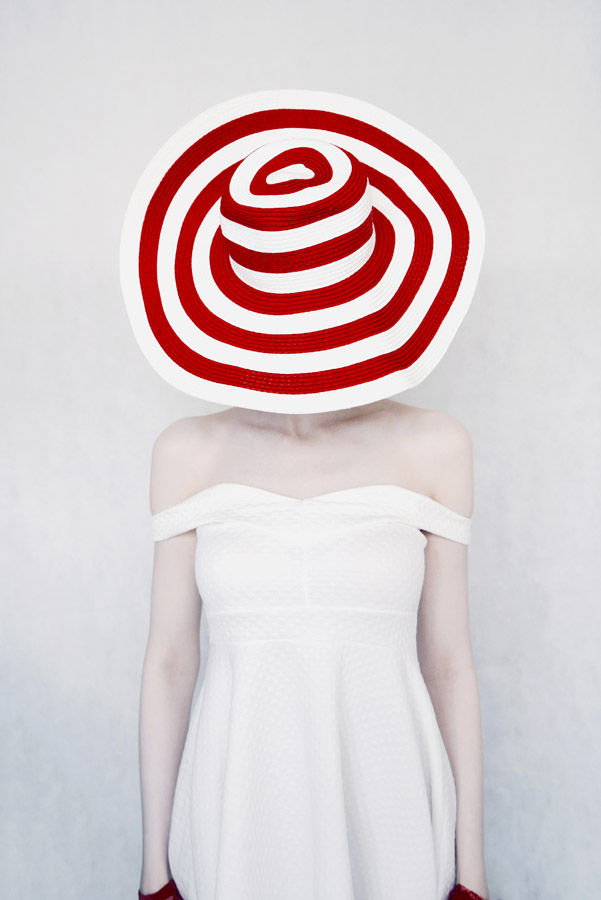
In Selfhood, the gaze is obscured, allowing the portrait to speak through gesture, posture, and atmosphere. How did this choice influence the way you build the female figure’s presence and the relationship between the image and the viewer?
Selfhood was conceived as a creative challenge to compose a series of portraits that had an obscured gaze, requiring me to try and construct a narrative without what is often the most arresting component of an image. As the series developed, I realised that what had started as a challenge to myself had become a way to articulate the tensions between a woman as both object and subject of the gaze. Consistently preventing the viewer from glimpsing the female figure’s eyes or knowing what or whom she is looking at gives the woman sovereignty and agency over her gaze. Although the woman is inherently objectified by the viewer, I also wanted to explore the unsettling idea that the viewer might also be objectified, gazed at without knowing whether they are being watched in turn by the portrait figure.
How did fairy tales, literature, and recognisable female figures first find their way into your work, and how did they gradually become part of your visual language?
The fantastical world of fairy tales has always sparked my imagination, and these whimsical narratives are often familiar frames of reference I reach for when conceptualising either an image or a project. Growing up, I was fascinated with The Wizard of Oz and Alice’s Adventures in Wonderland in particular, and their narratives about reclaiming agency and resilience have remained with me. Their stories and iconic imagery seem to have resonated with many others, forming a core of our cultural consciousness. I think this gives my work a shared visual language, allowing viewers to connect with my images while enabling me to communicate narratives that draw on this culture in order to investigate it. Fairytales have been retold and reimagined for many generations, forming a history of adaptations and contexts that my work both acknowledges and contributes to. I am especially interested in examining the archetypes of women created within these narratives, which have been perpetuated and continue to shape our expectations of women’s roles in society. I use the tropes and iconography of these recognisable female figures to push against rigid and entrenched ideas of femininity.
Not In Kansas: In Search of Courage Not In Kansas: Lions and Tigers and Bears! Not in Kansas
Not In Kansas: In Search of Courage; Lions and Tigers and Bears!; Not in Kansas
When you begin a new series, where does the first impulse usually come from, the one that sets an entire world in motion, and how does that first spark go on to shape character, space, and atmosphere?
I am not sure where the ideas come from! Whatever that initial flash of inspiration is, it can take a long time to form a fully-fledged concept in my head before beginning to think about the practicalities of executing it. The concept must stand up to the rigours of planning and logistics that are required to set up a shoot, meaning that it can be weeks, months, or even years before I am ready to capture a new project. When I do reach the planning stage, it can be difficult to match my desire for a certain character or atmosphere with what I can achieve in terms of location and costume. If the initial idea can withstand the practical demands of the real world, I continue to develop it until it becomes a fully-fledged narrative.
My original idea for Not In Kansas, for example, was a model wearing Dorothy Gale’s ruby-red slippers in a supermarket. As I thought through this vision, I realised that I wanted to capture the tension between reality and fantasy: the banality and mundanity of a modern-day supermarket set against the fantasy of escape symbolised by the ruby slippers, which immediately evoke The Wizard of Oz. Ultimately, I never realised this vision, as I did not want the overall narrative of the series to feel too prescriptive or literal.

In (great) Expectations and Hollywoodland, you work with stylised and instantly recognisable images of femininity. How did those visual worlds help you explore beauty standards, social expectations and the roles society continues to assign to women?
I continually draw on my fascination with classic cinema and the glamour of Hollywood’s golden era to offer a visual shorthand for exploring tension, disillusionment, and objectification. I use nostalgia for the era’s elegance, along with its corresponding gender hierarchies, as both inspiration and material for interrogation. Such recognisable images of femininity are artificially crafted on the silver screen and belie deeper psychological struggles that my work seeks to grapple with. Both series examine how the claustrophobic pressure to conform to a saccharine image of the perfect wife and mother continues to be felt today, as ever-changing beauty ideals, career ambitions and domestic models push the ideal of the perfect woman further out of reach.
In No Place Like Home, the idea of home takes on a layered and deeply emotional resonance. As the series evolved, how did your own understanding of home begin to shift?
One of the final scenes in The Wizard of Oz has always stayed with me: Dorothy repeats the mantra ‘There is no place like home’ and, with three clicks of her ruby slippers, transports herself back to Kansas. The power of wishing to return home seems enough to take her back to another time and place, yet in real life, we can never return to a past place or life. This series explores the desire to go back home, to both a physical and imagined place, in the hope of finding yourself again. The two characters in the series act out this inner battle between a fantasy of the previous self and the present, real self, within an imaginary doll’s house where the two female figures fight against each other and against the images of, and desires for, home projected from childhood. As I planned out the series, I realised that I wanted the location to be a doll’s house to reflect these ideas of home as both a material and imagined place. Reflecting on my own experiences with this traditional childhood toy, I became conflicted as fond memories clashed with the realisation that this miniature domestic world also taught young girls the roles they were expected to take on in the home. As the series evolved, my own imaginaries of home became less rose-tinted, or perhaps ruby-tinted, as I realised that you cannot go home again.
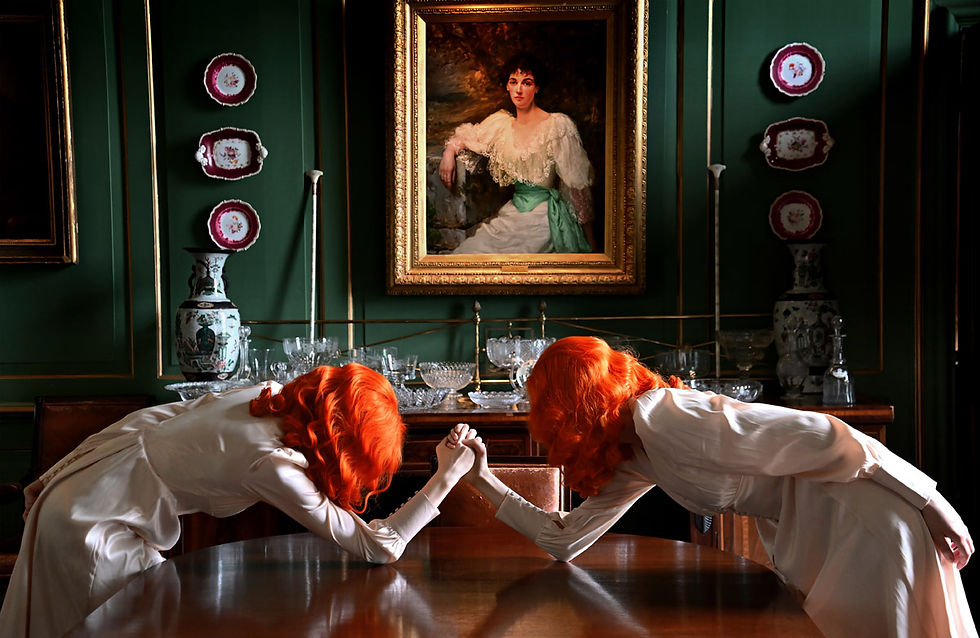
Your photographs leave room for silence, ambiguity, and personal interpretation. How do you decide what the image needs to say clearly and what it should leave for the viewer to discover?
I want the images to challenge viewers to reconsider the ways in which femininity is both celebrated and constrained.
I take what is familiar and make it strange. I use recognisable female figures from literature, film or popular culture, then defamiliarise and destabilise them through staging, narrative and location, in order to encourage audiences to engage critically with the imagery and the ideas it provokes. Using familiar visual languages gives viewers a foothold in my fantastical worlds, allowing them to make their own interpretations and discoveries, informed by their own understanding of these characters.

Looking at your series as a whole today, what is the strongest thread running through them, regardless of story, figure, or setting?
At the heart of my artistic vision lies a profound fascination with the multifaceted female experience. To examine what it means to be a woman is also to challenge the many preconceived notions of female identity shaped by cultural expectations and social norms. Throughout my work, recurring questions emerge about navigating pressures to conform to societal expectations of femininity; self-perception, identity and collective notions of womanhood; and the conflict between strength and vulnerability.
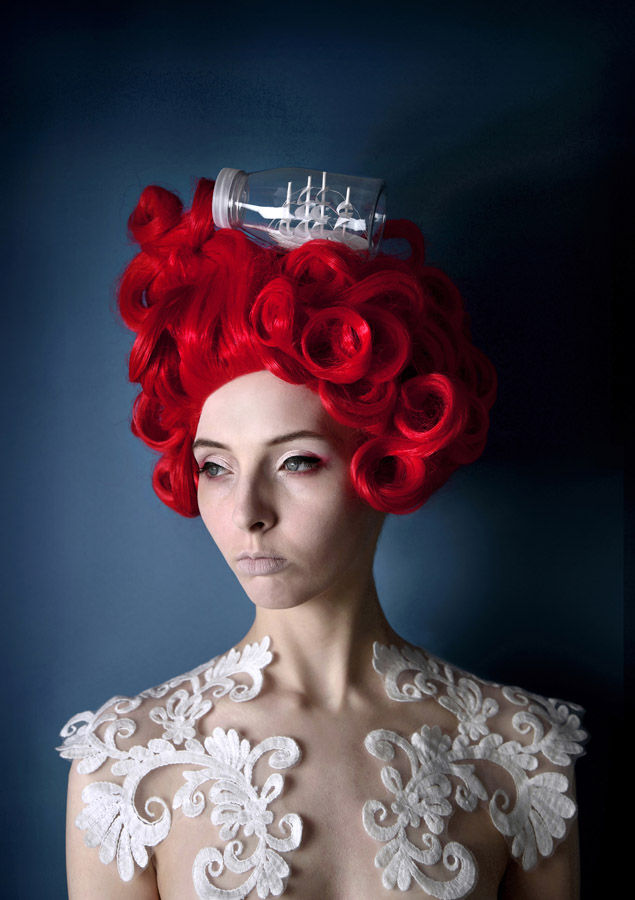
Ruby-red slippers carry, in Vicky’s work, a longing to leave; hair is bound to the body and the possibility of liberation; and the doll’s house recalls childhood alongside a girl’s earliest ideas of home. When the eyes remain obscured, the viewer does not know where the gaze is directed, or whether it is meant for them at all. Her heroines come from stories we recognise, but in the photographs, they no longer follow the path once set out for them. They can change direction, leave the tower or step out of the frame, taking with them what they do not have to reveal.


