


ewigundendlich: Death at the Heart of Life
- Apr 28
- 3 min read
Updated: Apr 29

In the series “ewigundendlich,” photographer and artist Ron Kuhwede transforms a subject that contemporary society often pushes out of everyday life into a visual space of intimacy, humour, unease, and unexpected tenderness.
Death is everywhere and still kept at a distance. We encounter it almost daily in films, series, news reports, and crime stories. Yet when it reaches our private lives, the family table, a conversation with friends, or the quiet of one’s own room, it becomes a subject we keep postponing.
The photographic project “ewigundendlich” begins in that fracture between the public image and intimate silence.
The title brings together two opposing sensations: eternity and finitude. From that encounter, a visual world emerges in which life and mortality draw closer through scenes of everyday life, ritual, and human vulnerability. Since 2023, the artist has been creating carefully staged images in which ordinary situations intertwine with funeral culture, farewell rituals, and the objects we usually associate with the end. The series is conceived as a cycle of 40 photographs, with 25 images already completed.

In these images, death steps out of the familiar visual language of black, fear, and closed doors. A hearse, a coffin, an urn, a hotel room, a park, a lift, a family moment, or an ordinary breakdown on the road become scenes that open a question: why do we only speak about the end of life when choice has already been taken from us?
The project builds its force through a precise tonal balance, in which seriousness, humour, and visual playfulness remain carefully held together. Humour brings closeness and loosens the rigidity with which death is so often approached. One scene carries absurdity, another grief; a third almost cinematic theatricality. The artist brings together pain and wit, ritual and everyday life, fear and curiosity, farewell and the life that continues.
The titles further shape the atmosphere of the series: “Der trauernde Clown” (“The Mourning Clown”), “Die Panne” (“The Breakdown”), “Das Sarghotel” (“The Coffin Hotel”), “Aufzug ins Jenseits” (“Elevator to the Afterlife”), “Bestattung per Versand” (“Final Delivery”), “Die Waldbestattung” (“Forest Burial”), and “Das Geschenk” (“The Gift”). These titles already show how funeral iconography enters situations that feel alive, full of movement, closeness, and human imperfection.
The artist makes a meaningful distinction between death and dying. Dying can be difficult, painful, and frightening. Death, as a fact of human existence, can be approached with greater calm and openness. From this distinction emerges the project’s central idea: to open a more natural conversation about the end of life, beyond fear, sentimentality, and silence.
This perspective gains particular depth when placed within a broader cultural frame. In many cultures, saying farewell to the dead is accompanied by colour, music, dance, gathering, and a sense of cycle. In the Western world, death is often linked to silence, heaviness, and withdrawal. The artist uses photography to question our habits: what has happened to rituals of farewell, to the language of loss, to the ability to speak about mortality before it catches us unprepared?


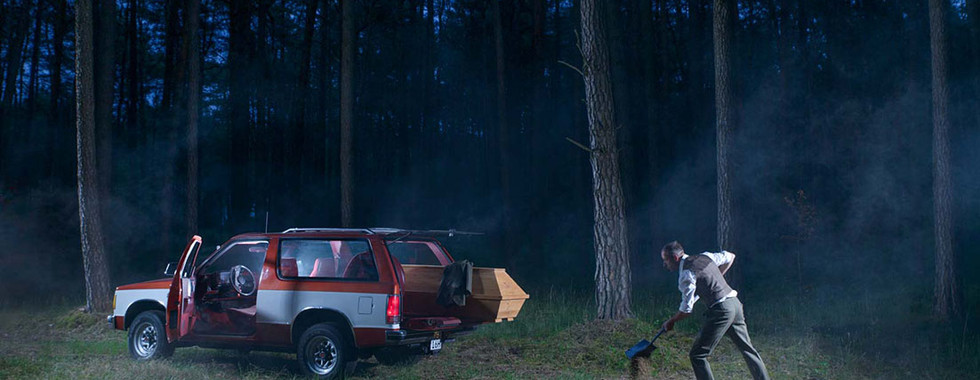


In this way, “ewigundendlich” grows beyond the theme of death and becomes a series about human connection in moments when masks fall away: about memory, fear, tenderness, care, and what remains when outer layers lose their importance. Loss often reveals how deeply people depend on one another, and the artist turns that closeness into images that are sometimes gentle, sometimes strange, and sometimes unexpectedly humorous.
Born in Leipzig in 1979, the artist has worked as a freelance photographer since 2005. His work spans portraiture, staged photography, and artistic cycles that explore the person beneath the surface. In “ewigundendlich,” that search takes on a particularly sensitive form: behind coffins, urns, hotel rooms, and funeral vehicles, people remain, with their fears, habits, memories, and the need to give some kind of voice to farewell.

A photobook is also in preparation, with international distribution planned, as well as an exhibition scheduled to open in 2027 before travelling to other cities. The project therefore expands into a broader visual and social conversation about farewell culture, about our habits of silence, and about the possibility of looking at mortality without theatrical darkness.
Often, a humorous detail appears first, while the same frame gradually draws out fear, memory, and the question of how we speak about the end of life. Death is drawn out of distant abstraction and returned to people, objects, customs, and the small imperfections of the everyday. The artist creates images that allow one question to linger: how do we want to live with the knowledge that everything we love is finite?
The value of “ewigundendlich” lies in the way a gaze turned toward the end brings attention back to life.
When death is given a place in conversation, life becomes more present, more concrete, and more precious.
And art, at its most powerful, shifts our gaze with enough subtlety that the world looks a little different afterwards.

Photographs: Ron Kuhwede


