Made-to-measure bags from Johanna Acevedo's Paris atelier
Originally published in AH Magazine, International Issue No. 7.
Presented here in a mobile-friendly format for subscribers.
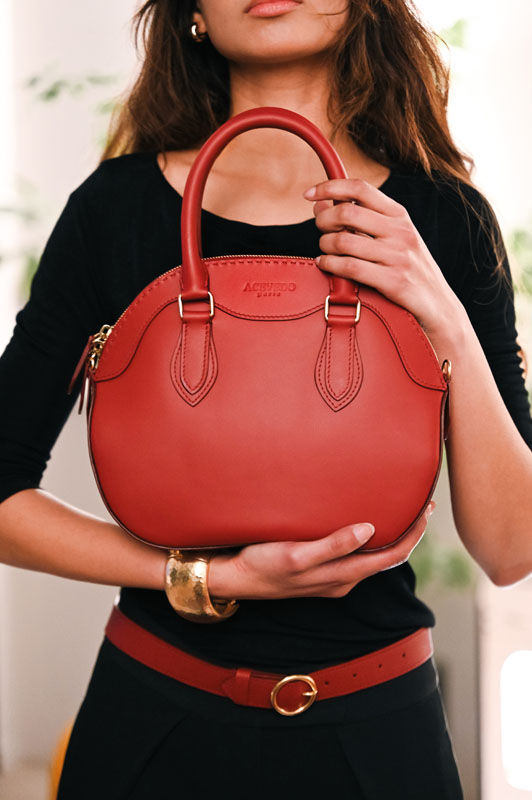
We visited Johanna Acevedo in her Paris atelier, where her made-to-measure bags are crafted one at a time, with each model personalised according to the client’s choices. Across the worktable are leather swatches, metal components, sketches, and the Rêve, Orsay, Aurora, and Mini Rêve models.
“A bag goes with you everywhere,” says Johanna Acevedo, who makes each piece by hand to order in her Paris atelier, in limited numbers throughout the year, for everyday life and travel.
Johanna sewed her first stitches as a little girl, learning to sew with her grandmother and already wanting to build a world of her own in fashion. Born in Venezuela, she grew up between Venezuela and the United States, living in several states. In the United States, she studied business and art, then moved to Italy and entered the world of garment construction, pattern cutting and accessory design. She spent more than five years in Rome and Florence learning every stage of a piece’s construction, and in Florence she refined her work in leather under Stefano Parrini, whom she still calls her maestro. It was during that period that she discovered leather and, with it, the bag as an object that stays with a person through everyday life and outlasts clothing made for a single occasion. She also began giving her bags intimate names, and Rêve, Paz, and Amour became part of the collection, evoking dreams, peace, and love. Later came experience at major houses such as Louis Vuitton and Gucci, and then Paris, the city where she wanted to open her own atelier and develop a creative language of her own.
The years she spent learning pattern cutting, construction, and accessory-making now allow her to guide each piece from sketch to finished bag. Some clients arrive with a very precise brief, carrying the things they use every day and knowing exactly what they need. Others begin with a prototype, then make it their own through colour, leather, metal, lining, or initials. “In the end, no two bags are the same,” says Johanna. With each client, the process begins with choosing the model, size, leather, and finishing details, followed by a making process that lasts between eight and twelve weeks.
ACEVEDO, Sewing Process. Photography: KC Photography Paris. ACEVEDO, Sewing Process. Photography: KC Photography Paris. ACEVEDO, Sewing Process. Photography: KC Photography Paris.
ACEVEDO, Photography: KC Photography Paris.
“I love designing for someone,” she says. “I love getting to know the person, understanding what they are looking for and why they need that item, then imagining how the bag will live.”
In Florence, she met a woman who had brought in a small leather bag for restoration, a gift she had received on her fifteenth birthday. Years later, she wanted to have it restored so she could pass it on to her granddaughter when she turned fifteen. Johanna is drawn to precisely those kinds of objects, the ones that stay with someone for a long time, hold memory, and one day pass into other hands.
Along the way, each bag takes on deeply personal details. For some, the lining, pockets, and compartments shaped around the things they carry every day matter most. For others, it begins with a sketch, a colour or a motif they want carried through into the finished piece. Johanna develops that initial request through conversation, sketching, material selection, and a precise finish. For styles intended for daily use, she often chooses finely grained calf leather, soft to the touch and durable enough to withstand everyday wear.
“It’s like you’re giving that gift of time. It’s kind of like you’re giving that part of you to someone.”
That commitment to handwork extends into projects with other artisans. Last year, she developed the Tempus collection in collaboration with Espero Atelier and the Musée d’Orsay. In Tempus, she brought together reflections on time, the museum’s clocks and the hours invested in the making of each piece. “Time is a gift,” says Johanna. “To devote time to work is to give it to someone else.” In the studio, she showed us three bags from that chapter. She developed Point de Vue in collaboration with Angelo Madonna, who shaped the arches and clock of the Musée d’Orsay in metal.
Designed alongside Pauline Schweizer and Frédéric Matagne, Les Temps Passés features wooden handles inspired by the clock, developed after repeated trials and the careful selection of the lightest and most interesting option. In Histoires Encadrées, created with Elise Lopez, she translated the world of frame restoration into a handle shaped like a picture frame. She develops capsule collections through annual collaborations with artists, in small series. In these pieces, leather, metal, embroidery, paint, ceramics, weaving, and wood come together through direct work with other artisans.
Musée d’Orsay Runway Bag. Photography: Cristina Suarez Silva. Musée d’Orsay Runway Bag. Photography: Cristina Suarez Silva. Musée d’Orsay Bag Collection. Photography: KC Photography Paris.
Musée d’Orsay Runway Bag. Photography: Cristina Suarez Silva. | Musée d’Orsay Runway Bag. Photography: Cristina Suarez Silva. | Musée d’Orsay Bag Collection. Photography: KC Photography Paris.
The seasons, façades, museums, the changing colours of the trees and the details she notices as she walks all shape the way she sees Paris. When she speaks of the bag that, for her, carries the spirit of Paris, she mentions Mini Rêve, a small crossbody piece that fits a phone, wallet, keys, and passport while remaining light and close to the body. She also mentions a backpack for city life, for cycling, for carrying a laptop and books, and for the kind of daily routine in which a bag needs to work well and look good. Alongside small and medium bags, backpacks, and laptop bags, she is also developing pieces for everyday travel, for days that call for practicality and something beautifully made.

When she speaks about luxury, Johanna ties it to quality, longevity, and the feeling that an object has been conceived for a particular person. She knows high fashion from the inside, knows the standards of the major houses, and knows what it costs, in time and labour, to make a single piece. In her atelier, luxury begins with the maker’s hand, fine leather, every millimetre considered, a lining shaped around someone else’s habits, and a piece of metal from a workshop where measurements are still taken by hand. She sees the atelier’s future growth in a healthy working environment, respected and well-paid people, and a small team through which knowledge is passed on at every stage of the process, from drawing and technical development to prototyping and making.

“I would like people to think about the brand as something that’s designed with purpose and thought for someone.”
Asked what she would like people to remember about Acevedo Paris, Johanna says she wants the brand to be seen as something designed with purpose and thought for someone.
Acevedo Paris | WEB
This article is part of AH Magazine Issue No. 7.
To experience the full digital edition, visit your private Digital Library.