


NICOLA SCOGNAMIGLIO
- 5 days ago
- 3 min read
Where Thought Takes Form

For Nicola Scognamiglio, a graphite mark on paper is physical evidence that something without form has begun to take shape. That is the starting point of Traces: the moment when thought ceases to be only thought and begins to register as presence. An architectural education in Naples and Venice, followed by years of building images layer by layer through 3D visualisation and cinematic image-making, did not lead him away from paper. It brought him there with greater precision, because throughout that time he had been returning to the same underlying question: how space, light, and atmosphere can hold something invisible while it waits to become visible.
Architecture and cinematic image-making shaped your path before drawing moved to the centre of your practice. Which elements of those disciplines still inform your visual language?
Architecture is the kind of discipline that stays at the base of every thought, instilling a structural mindset that never really leaves you. Cinema did something different: it changed the way I look at reality, at light, at how a scene holds meaning.
In Traces, you explore the moment when thought begins to take form. What does that passage from inner experience to image look like in practice?
It is the act of drawing itself. The series is about the traces we leave through thought and movement. Sometimes I begin with something in mind, and drawing becomes the most natural way to express it and freeze it, to give it a presence it didn't have before.


You have described drawing as a form of testimony. What do your works bear witness to?
A mark on paper has the power to reveal what is latent.
It is physical: you apply pressure, and something emerges. As a thought, a vision, a feeling begins to form inside you, you can watch it appear and reveal itself on the surface. That moment of appearance is what I try to capture.
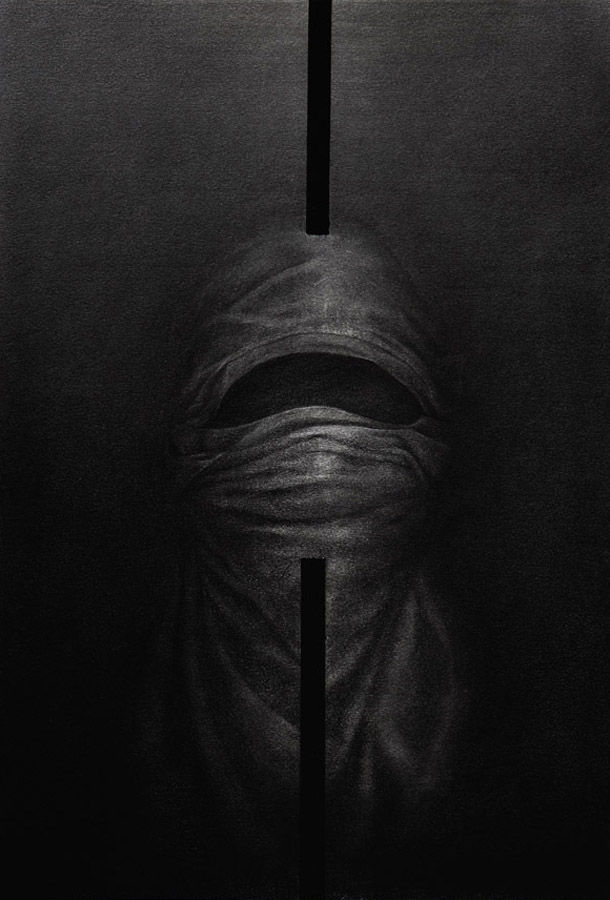
In works such as Idiopsis I, Threshold and Mask, the subject remains partly veiled. What does that partial concealment open up for you?
Showing less helps you focus on what remains. Concealment is a way of highlighting: what is withheld becomes more present, not less.
Your practice moves between drawing, photography and sculpture. How do you recognise the medium an idea belongs to?
I don't, and often the same idea can be explored through different mediums. Photography and drawing, for example, work in almost opposite ways for me. One notices things on the outside, the other looks inward. One is sparked by light as it exists in the world, the other can imagine its own. One is about grasping a moment before it disappears; the other needs time to finally emerge.
Titles such as Amor Fati, Threshold and Mask carry real conceptual weight. How does the relationship between title and image develop in your work?
Naming plays a role in completing a concept. The right title can guide the viewer toward certain areas of thought, or deliberately away from others. You can still form your own interpretation of an image, and that's welcome. But the title is the hint: it tells you what I was thinking of.
As you bring Traces to a close and develop a new body of marble sculptures, what shifts in your relationship to form as you move from paper to stone?
A marble sculpture can still belong to Traces, because Traces is a body of work, not just a series of drawings. A sculpture is also a trace: not the kind left by a hand moving across paper, but a crystallisation of an idea in stone.
Ultimately, it is still something I leave behind.


The marble sculptures he is now developing remain closely tied to Traces. Stone is also a kind of trace, formed through subtraction rather than movement. The material changes, but the moment that holds his attention remains the same: the one between pressure and appearance, between intention and form. Everything Nicola Scognamiglio has made, from rendered urban scenes to graphite on paper, returns to that single place.

Nicola Scognamiglio


