AGUSTINA GARRIGOU
Change as Form

In Barcelona, she shapes ceramics as a series of chapters on identity and migration, and on tradition in motion, shaped by contemporary life.
Agustina Garrigou thinks of ceramics as a process without an endpoint. In her work, form grows out of movement, lived transitions, learning, and the gradual release of fixed frameworks. Between industrial design and hands-on making, between Argentina and Barcelona, between inherited traditions and contemporary life, she has developed an artistic language grounded in change.
Her ceramic forms read like notes on an identity in motion. They echo natural processes, geological layers, and organic transformation, yet a personal story always sits at their core. Each piece belongs to a wider whole, a chapter in a single narrative that does not repeat itself but continues to evolve, shift, and deepen. Agustina builds her series as streams of thought, allowing the material to shape her choices, and letting chance leave its mark.
In this conversation, she discusses her path from design to ceramics, the wheel, patience, glazes, and the limits of control, as well as migration, tradition, and the need to approach classical forms through a contemporary, personal lens. In her practice, ceramics become a place where past and present meet, intertwine, and continue in a new form.
We’d love to understand your journey better. Can you share how your path led from industrial design to ceramics, and was there a particular moment or decision that shaped the artistic direction you are pursuing now?
As a child and teenager, I was really interested in car design, and then that shifted to furniture design, which led me to choose Industrial Design for my university studies. But the problem I found was that during my career, I never got the chance to work with my hands. Instead, I spent many hours on the computer. So, when I finished university and started working at a design studio, I knew I had to try a hobby. I remembered that, for a university project, I had the opportunity to work with a ceramicist, so I contacted her, and she recommended a ceramics school, back in 2010. In the first class, I fell in love with ceramics, and it has lit up my spirit ever since.
Years later, I moved to Barcelona for a Master’s in Furniture Design, secretly wishing to study ceramics at a prestigious school, but I wasn’t ready to “give up” my design career, and I also wasn’t confident enough to make the shift to ceramics, as I felt that I was “throwing away” all the years invested in studying design. In Barcelona, I started working at a kitchenware design studio, and after work, I rented a space at a ceramic co-working studio.
Fortunately, my bosses offered me the chance to make a special ceramic edition for them that I would be able to sell in their showroom, and that was the start of my business. Two years later, I quit my job to work full-time in my studio. The moment I felt I was ready to sell helped me make the decision to choose the artistic path, but it took me at least five years. I didn’t want to rush and sell work I wasn’t proud of.
What drew you to clay at the beginning, and what has become most important to you in your relationship with the material over time?
I was drawn to the plasticity of clay, the many possibilities of shaping it, and the sense that I could take an idea and bring it to life in a short time, by myself, with only one material. I fell in love with wheel throwing, and with learning a new skill that requires patience and a love of the process, rather than the result.
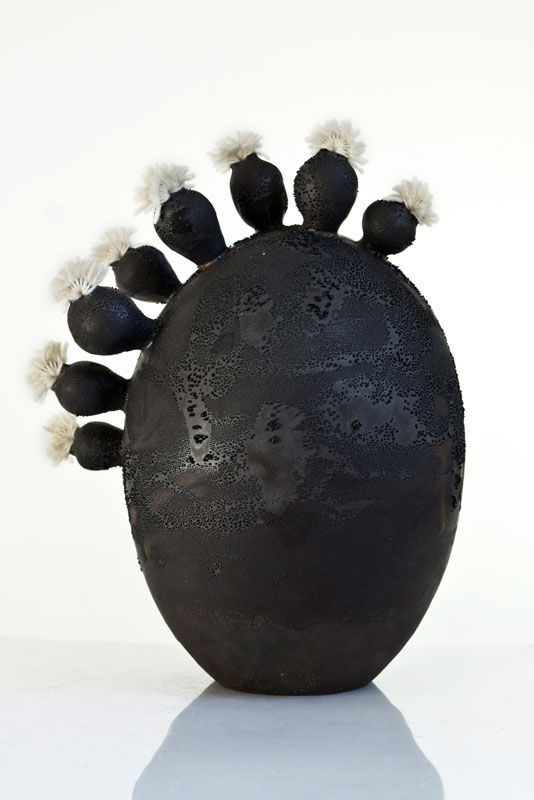
Mars Particle Crustacean Vase
When you begin a new piece, what does the start in the studio feel like? Describe it as a scene: what do you do first, what do you notice, and what are you searching for?
I believe that, in my artistic practice, I’m always writing a story, always the same story, but with different chapters. I think that’s the exercise of choosing to have a style, and it isn’t about aesthetics in themselves, but about the story I’m always trying to tell. So, most of the time, while I’m making a piece, I start to imagine what the next one could be, because it would be the next chapter of the one I’m making now.
Other times, I have an idea, and then I let it sit in my mind for days. Then, one night before going to sleep, I start shaping the image of the new piece in my head, adding more details each time until it’s almost complete. Then I sketch, and I define the dimensions. While I’m making the piece, changes always occur, and I leave space for happy accidents to happen. It’s a dance between control and chance.
When an idea grows into a series, what helps you stay true to it while keeping each piece fresh and fully alive in its own right?
Great question. I think I need to repeat it a few times to understand what I’m doing. So, when I’m making a series, I like to create many versions of the same idea, because they’re always slightly different from one another, and it’s in the whole that I find meaning. Going back to what I was saying about writing a story, I feel I’m always writing the same story, no matter how it looks. Thinking this way allows me to try new things.
I allow myself to change and to follow ideas that don’t seem closely connected because I believe that if they show up, it’s because, in the end, I’ll be able to connect them to my work in some way. I read and look at images that feed me and stay in the background, often unconsciously shaping my style.
Which part of your process asks the most patience of you, and what has that part of the work given you as an artist?
At the beginning, when I was learning how to throw on the wheel, learning this craft demanded a lot of practice and patience from me. It was important to understand the limits of the material and how close you can get to them in order to make the best pieces. When you’re throwing a piece and you want it to be great, you have to come close to those limits, for it to be light and evenly made. With experience, this craft becomes more natural, and your hands and body learn to move almost automatically.
The next challenge is glazing, which requires the most patience from me today. Some days I’m not in the mood for glazing, and it’s better not to do it that day. When you glaze a piece, you have to stay aware that this is what brings out its full potential, and nothing should be automatic about it. Although my glazing style is quite free, leaving room for chance to shape it, it took me many years of research to achieve a glazing style that looks organic yet still controlled. This taught me that freedom within a few rules and control is stronger than freedom on its own, a bit like the way society works.
Nature is an important source of inspiration in your work. What most often sparks a new form for you, and how do you carry that impulse into ceramics in a way that still feels distinctly yours?
Let me tell you something: although my work might seem rooted in the abstract shapes of nature, in the end, I’m always talking about myself. In my Potatoids series, I wanted to explore the “undefined” and experiment with glazes. I needed a shape that could resemble many things, but also nothing in particular, and I used it as a canvas to explore glazing techniques.
Later on, my work turned towards geological processes and the possible changes that human intervention might cause on our planet, as in the Dystopian Mineral series. All along, I tried to express these ideas through abstract shapes that still feel organic. In a way, I’m always trying to make my pieces look like a collaboration between myself and a strange, unfamiliar nature.
What are you most focused on in the studio these days? If you single out one piece or series you are currently developing, what do you hope to explore more deeply in the period ahead?
The chapter I’m working on today is a series that could be summed up in one word: “change”. Change is inevitable, although we sometimes resist it. It’s part of our nature. Ceramics wouldn’t exist if ancient cultures hadn’t moved from one place to another, sharing knowledge and traditions. People move, traditions change, and nature is altered.
Where does all this come from? From my attempt to understand why I’m unable to repeat traditional ceramics, although I respect it deeply. I don’t feel fully connected to what is traditionally mine. I’m the granddaughter of European immigrants in Argentina, I was raised there, and then I migrated to Spain. Identity is a mix, and it isn’t permanent. Tradition, on the other hand, resists change. With globalisation and migration, we see traditions and landscapes shifting. Plant species grow far from their origins, and cultures blend and transform.
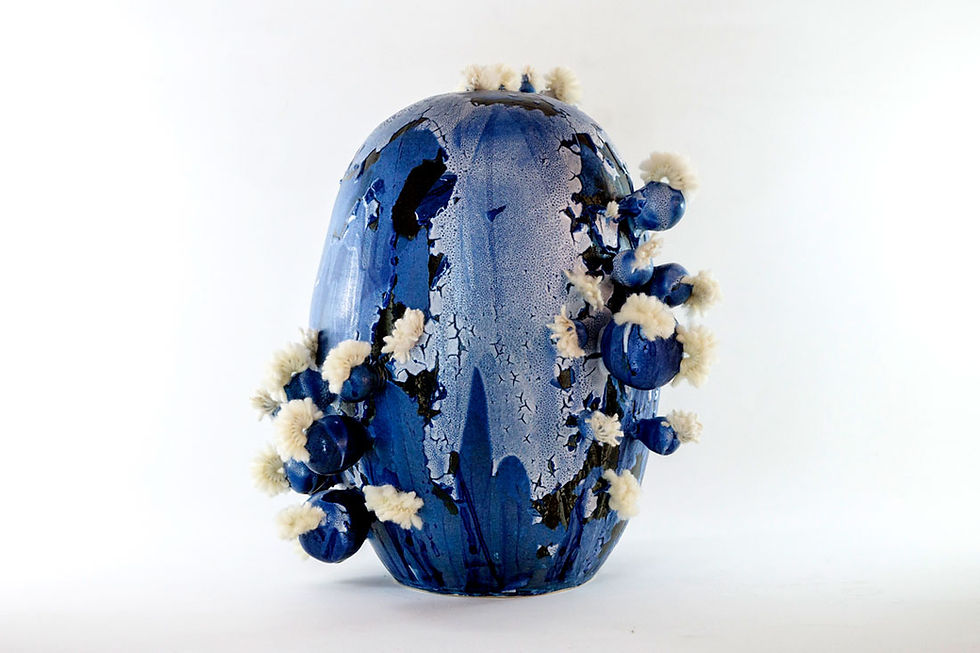
So, to bring these ideas into my next series, I want to explore change within tradition. Change might show up through the natural aspect of the work, while tradition might be represented through classical forms. As one of the first pieces in this series, I tried to make a classic Korean Moon Jar, but the result ended up far from traditional. Its nature shifts because it’s made by me, someone who isn’t Korean, and who carries her own background. Visually, it begins as a vase with a clean, quiet shape, and then it transforms: colours shift, textures mature through the contrast between glossy and dry surfaces, and blisters emerge like traces of a volcanic eruption. I now call it a Mars Jar.
I will research many different cultures, from classical Greek and Spanish to Indigenous cultures from Argentina, and reflect on them, so I can interpret them in a way that feels authentic to me.
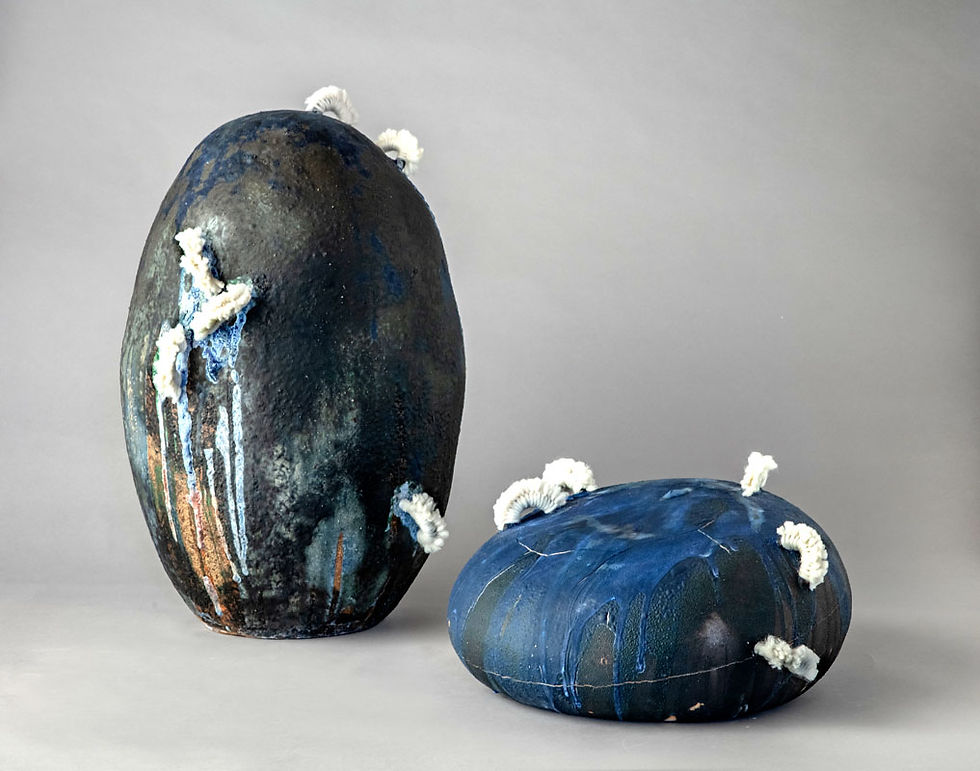
In her studio, change is present in form, in glaze, and in the detail that takes shape over time. The conversation ends on the threshold of her next series, right where an idea becomes clay in her hands.
Agustina Garrigou