


Felicity Hammond
Originally published in AH Magazine, International Issue No. 7.
Presented here in a mobile-friendly format for subscribers.
Between the Image and the World That Produces It
Felicity Hammond belongs to a generation of artists who approach photography not as a window onto the world, but as part of the systems that actively shape it. Working across photography, installation, sculpture, and digital imagery, her practice examines how images are produced and circulated, and how they participate in the construction of space, value, and meaning. She studied photography at the Royal College of Art in London and later completed a PhD at Kingston University, where she now teaches. Her work has been exhibited at institutions including C/O Berlin, The Photographers’ Gallery in London, and Kunsthal Extra City in Antwerp, and she is the recipient of the Lumen Prize for art created with technology.
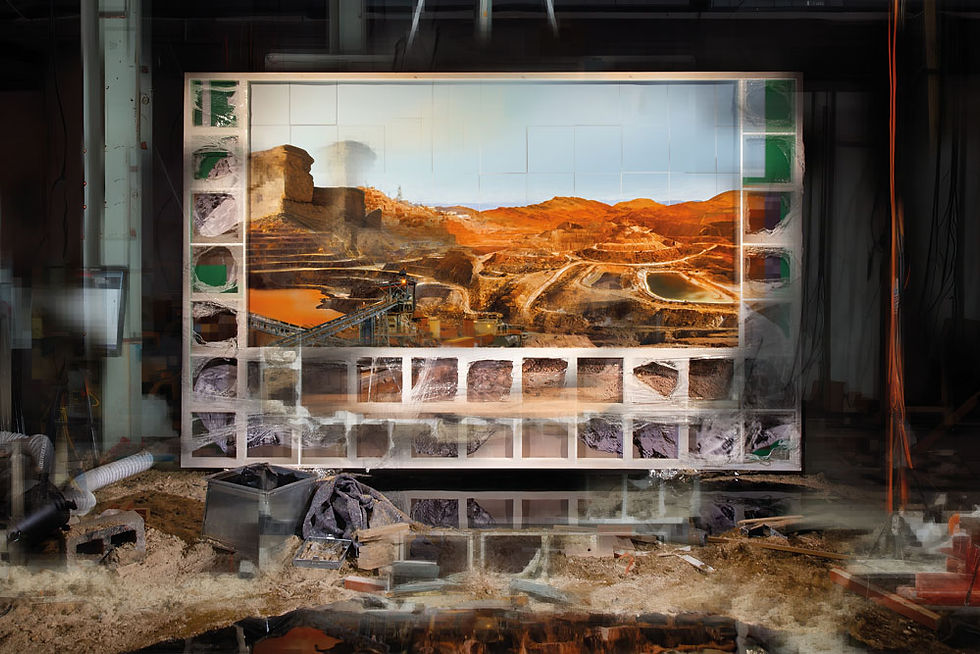
In her more recent projects, particularly the series Variations, Hammond turns her attention to the relationship between geological mining, data mining, generative AI, and the infrastructures that sustain these processes. From this line of enquiry emerge works in which image, material, and system are read together.
We spoke with Felicity Hammond about where the image begins, what shapes its role today, and what it means to work with photography in an age defined by digital infrastructures.
Your work shows that digital images are not separate from material reality, but depend on infrastructure, energy, and resources. When did you begin thinking about this physical dimension of the image?
I think I can trace that idea back quite a long way, even before generative AI became widely accessible. My artistic research really began with an interest in computer-generated imagery, around 2011 or 2012, when London was undergoing significant urban change in preparation for the Olympics. At that time, we were seeing large billboards covered with computer-generated images of new developments. These weren’t images intended for close looking, they were marketing material, appearing and disappearing as quickly as the buildings themselves.
I became interested in turning my camera back onto those images and looking at them critically. That was the point where I began thinking about photography not only as a tool of representation but as something that could reveal much more about society, the economy, and politics.
More recently, particularly with the rise of generative AI over the past few years, that interest has shifted towards infrastructure – towards data centres, labour, energy, and all the very physical systems that sit behind the image. The work I’ve been making tries to draw those processes out, to slow them down, and to make them visible.
In your work, photography often moves beyond the flat image and becomes an object, structure, or installation. What does working spatially allow you to express more clearly than photography alone?

I think it helps to go back a little, because that’s where this way of working began. I was interested in what I would describe as a kind of reverse causality of the image.
If you think about renderings of new developments, for example, the image exists before the building. That image is used to finance the project, to market it, to sell something that doesn’t yet exist. So you have an image that appears photographic but actually causes something material to happen.
In the city, I became interested in those moments where digital images and physical architecture collide – where a billboard showing a completed building sits in front of a building still under construction. You get these strange surfaces where digital space and physical space seem to overlap.
By taking photographs of those images and transforming them into objects – printing them onto materials, shaping them, producing them as sculptural forms – I try to draw attention to that relationship. It becomes a way of asking what the distortions and instabilities of digital imagery might point to in physical space.
In more recent work, I’ve also brought my own body into the process, as a material presence within the image. Generative images, particularly when they depict people, are made from extracted data – from all of us, in a sense. I wanted to make that visible, to emphasise that these systems are built upon people and lived experience.
The key idea was extraction. Both geological mining and data mining are processes of taking.
In the project Variations, you connect geological mining and data mining. How did that connection gradually take shape in your work?
For me, the key idea was extraction. Both geological mining and data mining are processes of taking. As someone working with photography, I’m very aware of its extractive nature. Historically, the camera has often been a tool of extraction, even of violence – a colonial instrument that takes, records, and appropriates.
With contemporary technologies, we see something similar in data scraping and data extraction – the taking of information and turning it into capital for large tech companies. I wanted to draw attention to those parallels.
With geological mining, we can see the physical impact very clearly – the scars in the earth, the visible disruption of the landscape. What interested me was how to bring that together with the less visible forms of extraction taking place in digital systems.
That connection unfolded through the work, often through collage and juxtaposition – for example, bringing imagery of lithium fields into relation with photographic tools, or creating sculptural works that combine the form of a camera with that of mining equipment. In that sense, the work begins to enact the very extractive processes it is addressing.

In your earlier works, cities and the visual language of property development already played an important role. In your more recent projects, this expands towards extraction, logistics, and digital infrastructure. Do you see these themes as part of the same broader investigation?
Yes, definitely.
At the core of both bodies of work is a critique of the economies that underpin them. In the earlier work, I was looking at how images construct the idea of the city and its future through marketing, development, and speculation.
In the more recent work, this investigation expands into the infrastructures that support contemporary technological systems. In both cases, I’m interested in exposing points of tension or instability within those systems.
With Model Collapse, for example, I use a term from machine learning, where models begin to break down when trained on their own outputs. But it also becomes a way of thinking about environmental collapse and broader systemic breakdown.
In the earlier work, I was already interested in the imperfections of computer-generated imagery – the pixelation, the distortions, the way those images are affected by their physical environment once printed and installed. Drawing attention to those flaws became a way of questioning the future they represent.
In V3: Model Collapse, the image appears to fragment and lose stability. Are you more interested in the aesthetic quality of that disruption, or in what it reveals about the system itself?
I’m much more interested in what it reveals about the system. The work isn’t intended as a direct critique in a documentary sense. There are other forms of practice that do that very effectively. What I’m trying to do is to put those processes into action.

I suppose the way I would describe it is that I insert myself into the process in order to enact it. The image goes through multiple transformations – it’s photographed, rephotographed, painted, reworked – and that labour becomes part of what the work communicates.
In doing that, the process can feel almost absurd, but that’s precisely the point. It draws attention to the fact that these images are not weightless or instantaneous, as they often appear, but are supported by complex and labour-intensive systems.
In V4: Repository, elements such as tests, contact sheets, raw files, and other traces of the process become part of the installation. At what point did you feel that the process itself should be visible as part of the work?
I was thinking about the repository both as a space of knowledge and as a space of concealment. It can be a library, but it can also be a place where things are buried, like a nuclear waste repository.
With generative systems, we’re usually presented only with the final output, not with the vast amount of material that goes into producing it. I wanted to include all of that – every fragment, every trace, even the communication that surrounds the production of the work. Part of that came from the scale of material being generated. The first two chapters of the project both included cameras within the installation, producing thousands of images. I ended up with an enormous archive, and it felt important not to set that aside, but to bring it into view. In that sense, the work reflects on its own production while also pointing towards the much larger infrastructures it relates to.
These images are not weightless or instantaneous, as they often appear, but are supported by complex and labour-intensive systems.
As someone who teaches photography today, what do you think young artists most need to understand about images in a world shaped by networks, algorithms, and digital infrastructures?
I think the key question is what we even consider a photograph today. Photography no longer needs to be tied to a camera. It can exist without one. It can be a simulation, a construction, a form of mimicry. These are the kinds of questions we discuss with students – where the photograph begins, where it ends, and whether we can still trust it.

Those questions have always existed, but they feel much more urgent now. It has become increasingly difficult to distinguish between what is real and what is generated, and that fundamentally changes how we relate to images.
In Felicity Hammond’s work, the image forms part of a broader chain that connects material, technology, labour, and space. It is this condition that gives the work its force: it operates at once as a visual experience and as a precise reflection on how images are produced in the contemporary world.
Photography, in her practice, enters space, shifts in form, and takes on a tangible presence. Through installation, sculptural elements, and carefully constructed relationships between image and material, the work addresses questions of infrastructure, extraction, energy, and digital systems, always articulated through a clear and deliberate visual language.
What emerges are works in which form, material, and process evolve together, opening up concrete questions about the image, technology, and the conditions under which they are produced.
Felicity Hammond | WEB
This article is part of AH Magazine Issue No. 7.
To experience the full digital edition, visit your private Digital Library.


