


Dominique Jaussein: The Body’s Signature
Feet marked by years of work, a back thrown into relief by light, hands and muscles caught between tension and stillness. In Signature gestuelle, Dominique Jaussein looks closely at the dancer’s body. Movement no longer appears as choreography; instead, it registers in muscular tension, the wear on the feet and the body’s relationship with the wood. He developed the series with George Oliveira, whose command of his own body became part of the photographic process. In conversation with AH Magazine, the photographer describes how the images were made, from the poses Oliveira proposed to the way he used light to give the body volume.

For years, you photographed opera and ballet, where the body is framed by movement, costume, staging and narrative. In Signature gestuelle, almost all of that disappears. How did your way of seeing change when you began to approach the dancer’s body as a ‘living sculpture’?
Robert Mapplethorpe once described photography as ‘a very quick way to see, to make sculpture’.
I therefore see George as an art object. I seek the perfect form, pure and aesthetic.
I pursue an intense, harmonious beauty, working with the human body as an abstract form, a true human sculpture defined by its lines of force, its power in stillness, its elegance and its freedom of expression.
It began as a wordless dialogue, a play of gestures and light, from which my images emerged, sometimes by accident.
Our natural and enthusiastic creative process gradually developed into a shared understanding, shaped by the unique rapport I built with George and by our discovery of each other’s personalities.
The magic of our photo sessions, George’s understanding of my vision and the natural way he shaped his poses through movement all made my work easier.
This dialogue of movement between George, master of his own body, and me, the photographer, allowed the sessions to flourish.
Every body has its own signature, its own identity, its own history and potential.
I follow it with my gaze.
I draw it into my space, into my soul.
And suddenly: ‘Stop, don’t move!’
The photograph is taken.
L’Homme qui marche, two works titled Équilibre and Symétrie, from the series Signature gestuelle. Photography by Dominique Jaussein.
George Oliveira’s face is rarely visible in the series, yet his body remains recognisable through posture, musculature and gesture alone. Where do you draw the line between freeing the body from individual identity and turning a person into an object, and how do you navigate the boundary between sculptural form, sensuality and eroticisation?
From sculpture and painting to photography and abstract art, artists have long sought to capture the essence of bodily beauty and convey profound emotions through curves and volumes. Sculptural form can explore sensuality and eroticism by translating desire, movement and the tactility of the human body into volume and texture. Artistic nude photography is a delicate practice that requires technical mastery, aesthetic sensitivity and deep respect for the subject.
The contemporary body has also become a primary site for exploring identity.
George’s only request was that I should not reveal his anatomy in full, to preserve his privacy.
Dance is a magnificent form of expression, and it begins with the dancer. His body is his voice, his paintbrush and his pen.
Line, stature, weight, proportion and muscle tone are the raw materials of his art. These fundamental elements are complemented by expertise, stylistic devices and techniques of posture and alignment. Body memory and personal experience also speak through the dancer, creating a unique sensory experience.
Dance sculpts and animates the body, its lines, postures and signs of intent, through a coded language that allows truth to express itself. His movements become a language bordering on the animalistic. His art allows him to assume unusual poses, pushing the limits of what is possible and teetering on the edge of imbalance.
He inhabits space poetically, engaging in a dialogue with gravity.
His signature: the territory of the body.
His identity: the danced gesture.
This gathering of impressions and expressions was an unforgettable shared experience. It was the kind of partnership every photographer dreams of.

As Jean-Christophe Maillot, choreographer and director of Les Ballets de Monte-Carlo, wrote in the dedication to the preface of my book, a signature is a mark one deliberately leaves behind to signal one’s identity, an identity that exists thanks to the extraordinary instrument the dancer has forged: the body.
Look at these photographs, and look beyond them to see how the dancer tears himself away from the ground and how he makes contact with it. Delve into the very heart of what dance is about.
Amid dreams, fantasies, desires and realities, our multiple identities seem central to how we view the body today and the questions we ask of it.
The contemporary body is a space of self-assertion, certainly, but above all a space for the pursuit of identity.
Fittingly, my series is titled Signature gestuelle.
The growth rings, cracks and grain of the wood often seem to continue the lines of the skin, muscles and feet. In L’Homme qui protège le monde, the figure encircles the wood while its deep fissure remains clearly visible. Did you shape the poses in response to the wood, and was the idea of the human figure as a protector present from the outset, or did that meaning emerge only once you saw the finished image?
For the most part, George suggested the poses. My role was to adjust them to suit the lighting and my vision of elegance, while staying true to the original project: sculpting the dancer’s body and the tools of his art.
The connection with the wood emerged during the shoot, revealing a sense of ‘osmosis between nature and the human form’.
In L’Homme qui protège le monde, the idea of the human figure as a protector only became apparent to us once we saw the finished image.

In Don de soi, the soles of the feet, a part of the dancer’s body that an audience almost never sees at close range, become the central subject. Were you interested in revealing what ballet’s apparent effortlessness usually conceals: discipline, physical wear and the cost of dance?
Yes, absolutely. The feet are what support the dancer.
When I see a dancer’s feet, I know how they make contact with the floor; when I see their thighs, I imagine how they launch themselves away from it; and when I see the texture of their skin, I perceive how they live and embody their roles.
I wanted to show the tools that a dancer forges throughout a lifetime, often at the cost of great sacrifice, to perform their art. I also wanted to show the pain dancers endure in their feet, which are essential instruments of that art.
This pain stems from the extreme stresses placed on the feet during weight-bearing, pointe work and demi-pointe movements, leading to muscular strain and specific physical ailments. More broadly, the physical toll on a dancer manifests as repetitive microtrauma and chronic musculoskeletal disorders, primarily affecting the feet, knees, hips and back.
Behind every graceful leap and seemingly effortless extension is a body subjected to immense strain. For many elite dancers, pain becomes part of the routine and injuries are unwelcome companions.
That is what I mean by the physical cost of the art.
Rather than focusing on the dance itself, my photographs sculpt the stillness that precedes movement, while the imprint of that movement remains etched into the dancer’s flesh.
The body is a living substance responding to its base, most often a simple block of wood with its grain and fissures. Bark, furrows and the textures of body and wood intertwine while remaining distinct, sometimes flowing into one another. Each becomes a continuation of the other.
The body’s humility, bordering on tenderness, wraps itself around the wood.
Age, mingled with the wood’s fissures, supports the body, offering it a base, a pedestal.
Curled toes, muscles strained to breaking point and the undulations of flesh weave their nocturnal gleams, while only the hands speak louder than silence.
It is a religion of features, skin texture, shadows and measured reciprocity.
It is an exchange between light and darkness, wood and flesh, solidity and fracture.
It is also a game of patience, whether in the work itself, the process or the resulting images.
On closer inspection, body and wood form a solid whole that could not have come together without the spirit behind it.

At times, the skin in this series appears soft and organic; at others, almost metallic or stone-like. How much of that effect comes from the lighting and the body itself in front of the camera, how much from post-production, and how much from the final Piezography print?
Understanding and mastering the art of body photography requires a deep knowledge of the techniques used to capture the beauty of the human body from different angles and under different lighting conditions.
Light is central to my work. It acts like a paintbrush, defining and revealing the contours and forms of the human body. Photographers often draw inspiration from great masters of painting, such as Picasso and Cézanne, to create a striking interplay between light and shadow. I favour black and white because contrast allows me to accentuate depth in the image.
The choice of model is equally important. Every body is unique and tells a different story. George’s story unfolds before my camera as he bares himself.
Post-production is another part of the process. Software such as Photoshop allows me to refine details, adjust contrast and work with light and shadow to emphasise the subject. These are the only adjustments I have made to my images.
Finally, I use Piezography Pro, a bespoke printing process. The system uses ten inks plus a gloss optimiser: four warm-toned inks, four cool-toned inks, a matte black and a photo black. The prints are produced using nine monochromatic inks.
The process produces gloss prints with very fine detail and matte prints rich in tonal nuance. It also offers variable tones and subtle gradients without visible banding, making it a highly flexible monochrome printing system.
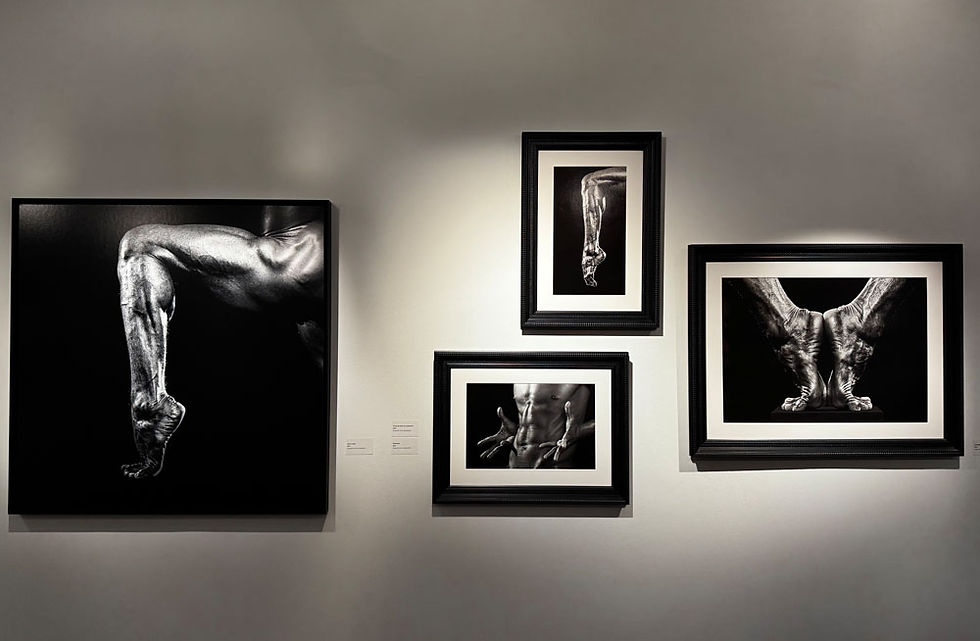
The photographer remains outside the frame in Signature gestuelle, yet the series emerged from your gaze, your choices and your close collaboration with George Oliveira. How much of Dominique Jaussein is actually present in these photographs? Is there something personal embedded in the series that a viewer could never know from the images alone?
I approached this phase of my work through a combination of delicate harmony and unsettling boldness. Those qualities reflect the sensual aesthetic of the images and my deep conviction that beauty can take many forms.
As a perfectionist, I sought aesthetic perfection in the body and its lines, focusing on muscles as they stretch and reveal their volume. The human body is central to that pursuit and transforms our perception of time and space.
But how does one create a sculpture from something as fundamentally flat as photographic paper?
Through nuances of light that reveal every detail.

I had the privilege of mastering this use of light at Studio Harcourt in Paris, renowned for its excellence and craftsmanship.
Like a sculptor, the photographer shapes the light around the subject, creating a symphony of shadow and light as intangible as a caress. The body becomes an object, a true living sculpture. Photography then captures in two dimensions a sculpture that, by definition, exists in three dimensions.
Through my images, I celebrate the grace and power of the human body, immortalising fleeting moments in which muscular tension, fluid movement and facial expression come together to create a striking aesthetic.
The dancer’s body is a living medium that simultaneously reveals and conceals itself in the fleeting instant when its forms and trajectories become visible.
By ‘writing’ with light, photography becomes a wordless language.
It preserves encounters that bring together art, vision and emotion.
Dominique Jaussein speaks of perfection of form, yet Signature gestuelle bears the marks of work: feet shaped by strain, skin under carefully directed light and the cracks and growth rings of the wood. George Oliveira proposes many of the poses himself; the photographer then adjusts them to suit the light and his own sense of form. Their shared process ends when movement pauses long enough to become a photograph.


